
Preserving Knowledge Across People, Projects, Policies, and Organizational Change
An ActionBoard.ai White Paper on Long-Term Memory, Institutional Knowledge, Temporal Context, Staff Transition, Project Handover, and Governed Organizational Memory
Abstract
Organizations rarely forget because information was never recorded.
They forget because the information required to reconstruct a decision is distributed across people, documents, systems and time.
A project officer leaves.
A country programme closes.
A consultant’s contract ends.
A manager moves to another office.
A new team inherits thousands of documents but little understanding of why previous decisions were made.
This is not merely a data-storage problem.
It is an institutional continuity problem.
The United Nations Joint Inspection Unit has explicitly described knowledge as a core organizational asset and has conducted system-wide reviews of knowledge management and succession planning. Its knowledge-management work identifies institutional memory and the transfer of knowledge from moving or departing personnel as organizational concerns.
AI introduces a new possibility.
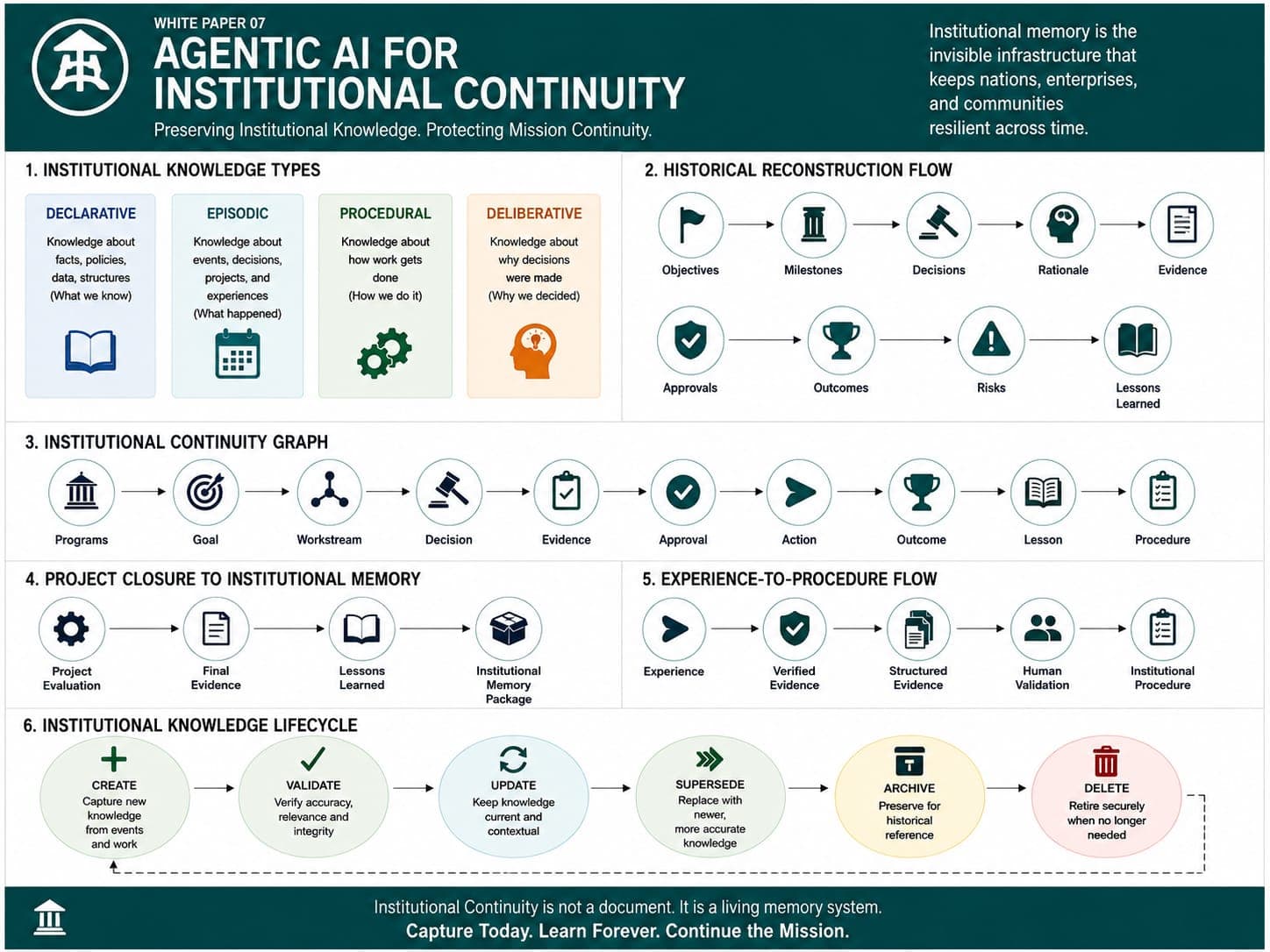
Instead of remembering only documents and conversations, an execution system can potentially preserve the relationships between:
goals;
evidence;
decisions;
approvals;
actions;
outcomes;
lessons.
Long-term AI memory research demonstrates why this is non-trivial. LongMemEval evaluates information extraction, cross-session reasoning, temporal reasoning, knowledge updating and abstention and found substantial degradation in sustained-memory settings.
Temporal graph approaches such as Zep attempt to preserve not merely facts but changing relationships over time.
ActionBoard’s Action Graph is currently described as preserving cross-session execution history, decisions and crystallized knowledge in a private long-term memory layer.
This paper asks:
Can agentic AI become infrastructure for institutional continuity rather than merely a tool for individual productivity?
1. The Handover Problem
Imagine a programme has run for three years.
During that period:
five project managers worked on it;
two donor requirements changed;
the implementation partner changed;
several budget decisions were revised;
multiple risks were escalated;
three different reporting formats were used.
A new programme manager arrives.
The official handover may consist of:
folders;
reports;
emails;
meeting notes;
spreadsheets;
dashboards.
The information exists.
The story of the programme does not.
2. Documents Are Not Institutional Memory
Documents are artifacts.
Institutional memory is relational.
A document may state:
Vendor B was selected.
Institutional memory asks:
Why Vendor B?
Which other options were considered?
Which policy applied?
Who approved it?
What happened afterwards?
Would we make the same choice today?
The answer may be distributed across:
procurement records;
email;
meeting notes;
budget systems;
project reports.
RAG can retrieve documents.
Institutional continuity requires reconstructing relationships between events.
3. The UN Has Long Recognized This Problem
The United Nations Joint Inspection Unit’s system-wide knowledge-management work treats knowledge as a strategic organizational resource and explicitly includes organizational memory within the scope of knowledge management.
The same report series includes succession planning as a separate system-wide concern, reflecting the importance of knowledge continuity when personnel change.
This makes institutional continuity an especially relevant entry point for AI in the UN system.
The pitch should not be:
“AI remembers your chats.”
It should be:
“The institution can retain governed, traceable knowledge about how work was actually done.”
4. Three Types of Institutional Knowledge
A useful memory architecture should distinguish at least three forms.
Declarative Knowledge
What is true?
Example:
The programme budget is $5 million.
Episodic Knowledge
What happened?
Example:
The March disbursement was delayed.
Procedural Knowledge
How should work be done?
Example:
For this donor, financial review must occur before submission.
These memory types require different governance and retrieval strategies.
5. The Missing Fourth Type: Decision Memory
Organizations also need:
Decision Memory
Decision memory answers:
What did we decide?
Why?
Based on which evidence?
Under which policy?
Who approved it?
What outcome followed?
This is particularly important because written policies rarely explain why a specific exception was made.
6. Long-Term Memory Is Not a Larger Context Window
One obvious approach to institutional memory is:
Store everything and place it in the model’s context.
This does not scale.
LongMemEval demonstrates that simply maintaining very long interaction histories does not solve core memory abilities such as temporal reasoning, knowledge updates and cross-session recall.
Institutional memory requires:
selection;
indexing;
temporal awareness;
relationship modeling;
updates;
abstention.
The system must know not only what to remember.
It must know what is no longer current.
7. Temporal Truth
Consider:
January
Country Director = Person A.
April
Country Director = Person B.
A poorly designed memory system may retrieve both.
A useful system understands:
Person A was correct for January.
Person B is correct now.
Temporal knowledge-graph architectures such as Zep explicitly model changing relationships over time.
This is crucial for institutional use because:
policies change;
staff change;
projects change;
budgets change;
partners change;
authorizations expire.
8. Historical Correctness Versus Current Correctness
Institutional memory must answer two very different questions.
Question A
What policy applies today?
Question B
Why was this decision made in 2024?
For Question A, the system should use the current policy.
For Question B, it may need the historical policy valid when the decision occurred.
Therefore long-term memory should preserve:
Valid Time
When was the information true?
and
Record Time
When did the system learn it?
Without this distinction, historical audit becomes unreliable.
9. The Action Graph as Institutional Memory
ActionBoard describes the Action Graph as a goal-linked DAG containing actions, decisions, queried sources and execution traces across sessions.
That structure can support a richer handover.
Instead of:
Project Documents
the incoming officer receives:
Objectives
What was the programme trying to accomplish?
Milestones
What has happened?
Decisions
What was decided?
Rationale
Why?
Evidence
Which sources supported the decision?
Approvals
Who authorized it?
Outcomes
Did it work?
Risks
What remains unresolved?
Lessons
What should be reused or avoided?
This is a fundamentally different handover experience.
10. From Search to Reconstruction
A new employee should be able to ask:
Bring me up to speed.
The system should not merely return ten documents.
It should reconstruct:
Current State
What is active?
Historical State
How did we get here?
Decision State
Which choices shaped the programme?
Obligation State
What remains committed?
Risk State
What requires attention?
Then allow every statement to be traced back to source evidence.
11. The Continuity Graph
A useful institutional graph could represent:
Programme
→ Goal
→ Workstream
→ Decision
→ Evidence
→ Approval
→ Action
→ Outcome
→ Lesson
→ Procedure
This transforms memory from:
a collection
into
a navigable operational history.
12. Staff Rotation
International institutions frequently operate with:
staff mobility;
consultants;
temporary appointments;
country-office transitions;
cross-functional teams.
The continuity problem grows as the organization becomes more distributed.
The important question becomes:
Does knowledge belong to the person who remembers it, or to the institution that needs it?
An institutional memory system should reduce dependence on individual recall while respecting access controls and privacy.
13. Project Closure Should Produce Memory
Project closure normally produces:
final report;
financial closure;
evaluation;
lessons learned.
An Action Graph could add another artifact:
Institutional Memory Package
Containing:
goals;
major decisions;
exceptions;
successful procedures;
failed procedures;
unresolved risks;
source provenance;
policy versions.
This package can then become available to future programmes where appropriate.
14. Lessons Learned Are Often Too Late
Organizations commonly write “lessons learned” documents after a project.
These documents have two weaknesses.
First, important context may already have disappeared.
Second, lessons are often manually summarized.
Agentic execution creates the possibility of capturing evidence continuously.
Instead of asking at project end:
What happened?
the execution graph already contains the trajectory.
Humans can then validate which patterns deserve promotion into institutional knowledge.
15. From Experience to Procedure
Procedural-memory research is increasingly focused on whether agents can extract reusable skills from workplace experience.
The AFTER benchmark contains 382 realistic enterprise tasks across six professional roles and 22 procedural skills, specifically evaluating transfer across tasks, roles and model backbones.
This suggests an important institutional possibility.
A successful workflow can eventually become:
Approved Procedure
instead of remaining:
Forgotten Past Execution.
16. But Memory Must Not Automatically Become Policy
This distinction is critical.
Suppose an employee repeatedly used a poor process.
Repeated history does not make it correct.
Institutional learning should therefore follow:
Execution
↓
Verified outcome
↓
Repeated evidence
↓
Human or policy validation
↓
Institutional procedure
Memory records what happened.
Governance determines what should be repeated.
17. Memory Confidence
An institutional memory item could contain:
Claim
Source
Date
Confidence
Status
Applicability
Superseded By
For example:
Knowledge
Partner consultation before project launch reduces implementation delay.
Evidence
Three programme reviews.
Status
Validated lesson.
Applicability
Community implementation programmes.
This is more responsible than presenting every remembered pattern as truth.
18. Knowledge Should Be Able to Expire
Institutional memory is dangerous if obsolete information remains indistinguishable from current information.
Memory therefore needs lifecycle controls:
create;
validate;
update;
supersede;
archive;
delete.
Long-term memory research increasingly identifies stale information, updates and temporal reasoning as central unresolved problems.
19. Privacy and Organizational Memory
A system capable of remembering organizational activity creates obvious governance questions.
Who can retrieve the memory?
Can one project see another?
Can one country office see another?
Can personal information be removed?
Can a departing employee’s private information remain?
The UN’s ethical AI principles explicitly include privacy, data protection and data governance.
Therefore institutional memory should be:
role scoped;
purpose scoped;
retention controlled;
auditable;
correctable;
deletable where required.
20. Memory Ownership
ActionBoard currently describes claimed RAOARA traces as belonging to the user and states that private Action Graphs can persist in designated storage rather than becoming platform-wide training data without explicit research consent.
For large institutions, this concept should expand into:
Organizational Memory Ownership
The institution should be able to determine:
storage;
retention;
export;
deletion;
model-training use;
cross-unit sharing.
Memory is potentially valuable intellectual property.
21. Institutional Continuity Scenario
Consider a three-year humanitarian programme.
A new officer asks:
What are the five things most likely to cause problems during the next quarter?
A continuity-aware ActionBoard could inspect:
current commitments;
historical delays;
previous risk decisions;
partner performance;
policy requirements;
open actions.
It then responds with five risks.
But critically:
each risk includes evidence.
That is not simply memory.
It is memory with institutional accountability.
22. The Handover Benchmark
ActionBoard should test institutional continuity directly.
Construct a simulated organization running for several years.
Include:
staff changes;
policy changes;
project transitions;
vendor changes;
contradictory updates.
Then replace the project manager.
Ask the system to reconstruct:
current status;
historical decisions;
outstanding commitments;
valid policies;
lessons.
Compare against:
document search;
vector RAG;
long-context LLM;
Action Graph memory.
23. Continuity Metrics
Handover Completeness
Correct critical facts recovered / total critical facts
Temporal Accuracy
Correct time-valid answers / temporal questions
Decision Reconstruction
Decisions with correct rationale and evidence / tested decisions
Stale Memory Rate
Obsolete knowledge presented as current / retrievals
Provenance Coverage
Memory claims connected to source / total substantive claims
Time to Operational Understanding
How long a new operator needs to understand the project.
That final metric may be especially meaningful institutionally.
24. Institutional Memory Versus Surveillance
A critical distinction must remain clear.
Institutional memory should preserve:
work;
decisions;
evidence;
approved knowledge.
It should not become unrestricted surveillance of employees.
The purpose is continuity.
Not behavioral monitoring.
This boundary should be encoded through data minimization and purpose limitation.
25. Why This Matters to the UN
The strongest UN use case for ActionBoard long-term memory is not autonomous decision-making.
It is:
Knowledge Continuity
A system that can help retain:
programme history;
approved decisions;
lessons learned;
project handovers;
source evidence;
institutional procedures.
This is lower risk than many rights-affecting AI use cases while solving an explicitly recognized organizational problem.
Conclusion
Organizations have spent decades building systems of record.
They can usually tell us:
which file exists;
which transaction happened;
which email was sent.
They are much worse at preserving:
why an action happened;
which evidence mattered;
what was learned.
Long-term agentic memory creates the possibility of preserving those relationships.
But useful institutional memory requires more than storage.
It needs:
temporality;
provenance;
governance;
access control;
validation;
forgetting.
The Action Graph provides a possible architecture for connecting these elements.
The larger research thesis is:
The most valuable long-term memory for an institution may not be a record of everything its people said. It may be a governed record of what the institution tried, why it acted, what happened, and what it learned.
That is the difference between:
Data retention
and
Institutional continuity.
Selected References — White Paper 07
- United Nations Joint Inspection Unit. Knowledge Management in the United Nations System, JIU/REP/2016/10.
- United Nations Joint Inspection Unit. Succession Planning in the United Nations System Organizations, listed in the JIU system-wide reports.
- Wu, D., et al. LongMemEval: Benchmarking Chat Assistants on Long-Term Interactive Memory.
- Rasmussen, P., et al. Zep: A Temporal Knowledge Graph Architecture for Agent Memory.
- Belikova, J., et al. Managing Procedural Memory in LLM Agents: Control, Adaptation, and Evaluation. AFTER benchmark, 2026.
- EverMemBench. Long-term interactive memory with temporally changing and multi-party information.
- UN CEB. Principles for the Ethical Use of AI in the UN System.
- ActionBoard.ai. Action Graph, cross-session memory, trace ownership and long-term memory architecture.