
Let’s get something straight.
AI is not broken.
Your system is.
And until organizations accept this, the cycle will repeat:
Invest → Build → Deploy → Disappoint → Abandon
Over and over again.
⚠️ The 80% Failure Problem
The statistic is everywhere:
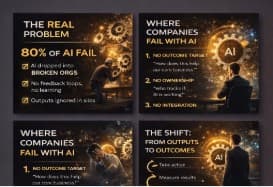
80% of AI initiatives fail.
But here’s the dangerous part:
Most leaders interpret this as:
- “AI is risky”
- “AI is immature”
- “AI is overhyped”
That’s not the truth.
The truth is far more uncomfortable:
Most organizations are not built to succeed with AI.
🧩 The Real Problem: Misaligned Systems
AI doesn’t fail in isolation.
It fails because it is dropped into environments that:
- Lack structure
- Lack clarity
- Lack accountability
Think of AI as a high-performance engine.
Now imagine putting it into:
- A broken car
- With no steering
- And no destination
What happens?
It doesn’t matter how powerful the engine is.
You’re not going anywhere.
🔍 Where Everything Breaks
Let’s go deeper.
1. AI Without Strategy
Most companies start with:
“Let’s integrate AI into our workflow”
But they never define:
- What success looks like
- What metric matters
- What outcome is expected
This is not strategy.
This is experimentation disguised as progress.
2. AI Without Ownership
Who owns AI outcomes?
- Data team?
- Marketing?
- Leadership?
If the answer is “everyone,” then the reality is:
No one owns it.
And what no one owns, no one optimizes.
3. AI Without Integration
AI outputs insights.
But insights are useless if they don’t:
- Influence decisions
- Trigger actions
- Change behavior
This is the biggest leak in the system.
Insight without execution = zero value
🧠 The Missing Layer: Decision Intelligence
Here’s what most companies are missing:
A decision layer
AI should not just answer questions.
It should:
- Recommend actions
- Prioritize decisions
- Execute workflows
And most importantly:
Track the results of those decisions
🔁 The Power of Feedback Loops
This is where everything changes.
The best AI systems are not static.
They are self-improving loops:
- Take action
- Measure outcome
- Learn from result
- Optimize next action
This is how intelligence evolves.
Without this loop?
AI becomes a one-time output generator.
🚀 The Rise of Agentic Systems
We are now seeing the emergence of:
AI agents that don’t just assist—they operate.
These agents:
- Conduct research
- Generate strategy
- Execute tasks
- Learn from outcomes
All within a continuous loop.
This is not the future.
This is already happening.
⚡ Why This Changes Everything
Because it shifts AI from:
- A cost center
To:
- A performance driver
From:
- Passive tool
To:
- Active system
From:
- Insight generator
To:
- Outcome engine
📊 What Winning Organizations Do Differently
The top 1% of companies using AI successfully follow a different playbook:
- They define clear outcomes first
- They build systems, not tools
- They integrate AI into decision-making
- They track real metrics
- They optimize continuously
They don’t ask:
“How can we use AI?”
They ask:
“What outcome must we achieve—and how can AI guarantee it?”
🔥 Final Insight: Stop Blaming AI
If your AI project failed, here’s the truth:
It wasn’t the model.
It wasn’t the data.
It wasn’t the tool.
It was the system around it.
🎯 The Shift You Need to Make
Move from:
- AI experiments
To:
- AI systems
From:
- Outputs
To:
- Outcomes
From:
- Tools
To:
- Intelligent, self-optimizing engines
Because in the next phase of AI:
The question is not who uses AI.
It’s who uses AI to consistently win.