
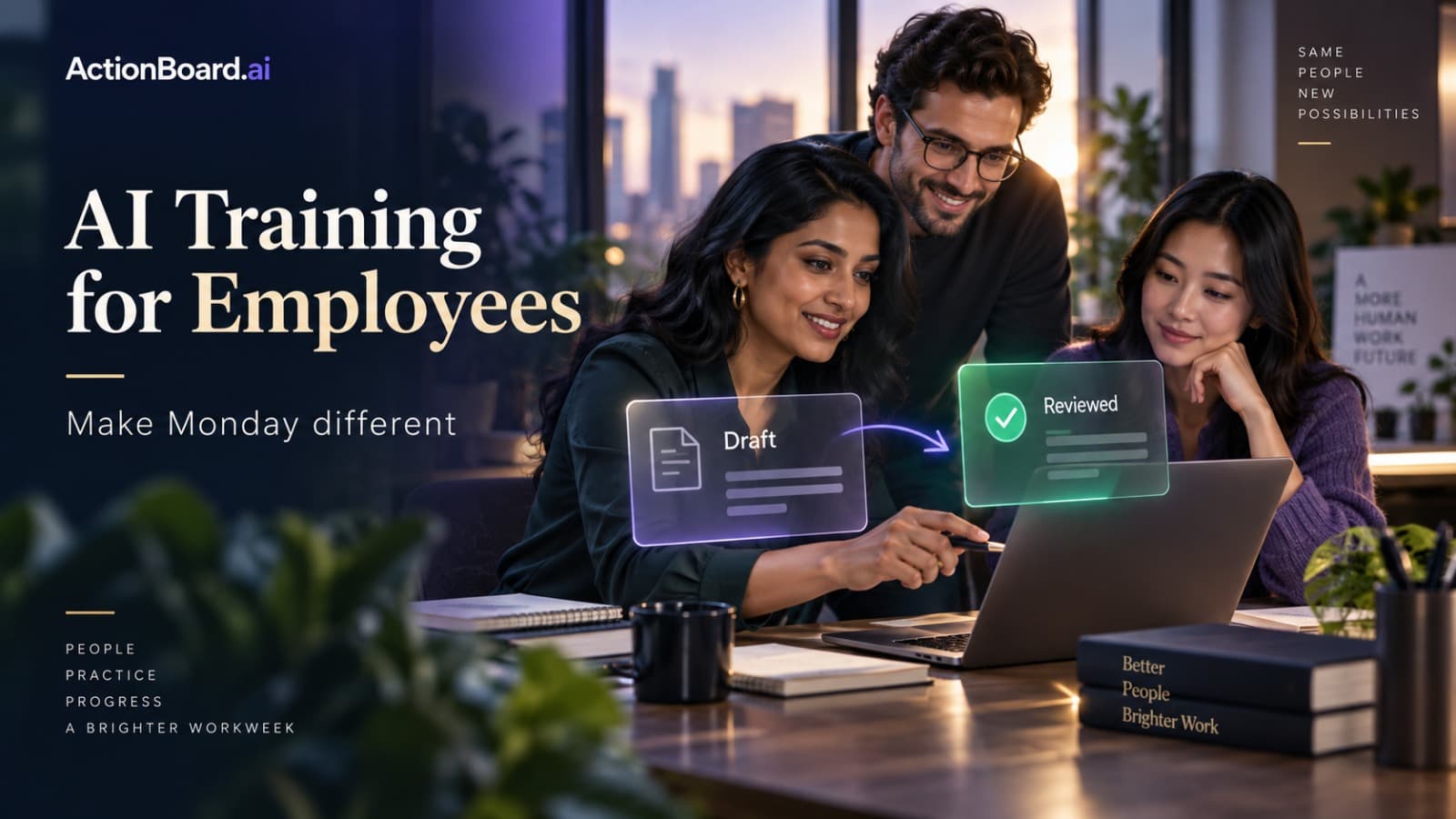
AI training for employees should change what happens at work the next day. Yet a great workshop can end with the same missed handoffs and slow approvals. The team knows more about AI, but the work still gets stuck.
Picture Monday morning. A sales lead needs a proposal. Someone writes a draft with AI, then spends an hour chasing the right price list. A manager sends it back because the scope is wrong.
The training helped with the draft. However, the team still needs a better way to finish the job.
Why AI training for employees needs real tasks
Start with the task your team must complete. Then teach the skills that help people do it well.
For example, a sales team needs to choose valid sources, check claims, and know when to ask for approval. A generic prompt lesson only covers part of that work.
McKinsey’s March 2025 survey found that only 21% of respondents using generative AI had redesigned at least some workflows. Its analysis also linked workflow redesign with stronger reported financial impact. This was a survey finding, rather than a promised return. [1]
The lesson for managers is practical. Connect each training session to a process your business can improve.
How ActionBoard connects learning with work
ActionBoard describes a six-stage loop: Recognize, Acquire, Organize, Act, Review, and Adapt. It connects a clear goal with the information, actions, and review needed to pursue it. [2]
For AI training for employees, that approach offers a useful structure. People can practice a skill while working toward a clear result.
Consider this example of a proposal pilot:
Define the client’s need and the owner of the task.
Gather the approved prices and service details.
Prepare the proposal using that context.
Ask the reviewer to check the scope and claims.
Use the feedback to improve the next attempt.
This is an illustrative pilot, so the team would need to confirm the setup and available connections. The goal is clear: help staff move from a draft to work someone can approve.
Measure the whole job
Before the pilot, record how long similar proposals take. Also note the number of corrections and the time managers spend on review.
Next, compare those measures during the pilot. A faster draft helps only if the full job gets easier. For instance, extra checks may cancel out the time saved on writing.
Ask three simple questions:
Did the team finish sooner?
Did reviewers request fewer changes?
Could staff explain why the final answer was sound?
Together, these checks show both progress and gaps. They also help leaders decide what to teach next.
Make the next Monday the test
Keep AI training for employees close to the work they do. Choose one task, give it a clear owner, and review the result as a team.
Then build on what works. Staff gain practice, and managers gain a clearer view of where support still matters.
Explore ActionBoard with one workflow that keeps getting stuck. Agree on the result you want to measure, and let the next Monday show what changed.
Sources