
Uploading a legal file is easy. Producing a responsible analysis from it is not.
A legal-AI system must do more than summarise the document.
It must identify relevant laws, retrieve similar judgments, distinguish strong authority from weak references, identify missing evidence and communicate uncertainty without pretending to know the future.
This is the purpose of the Legal Orchestrator’s case-analysis pipeline.
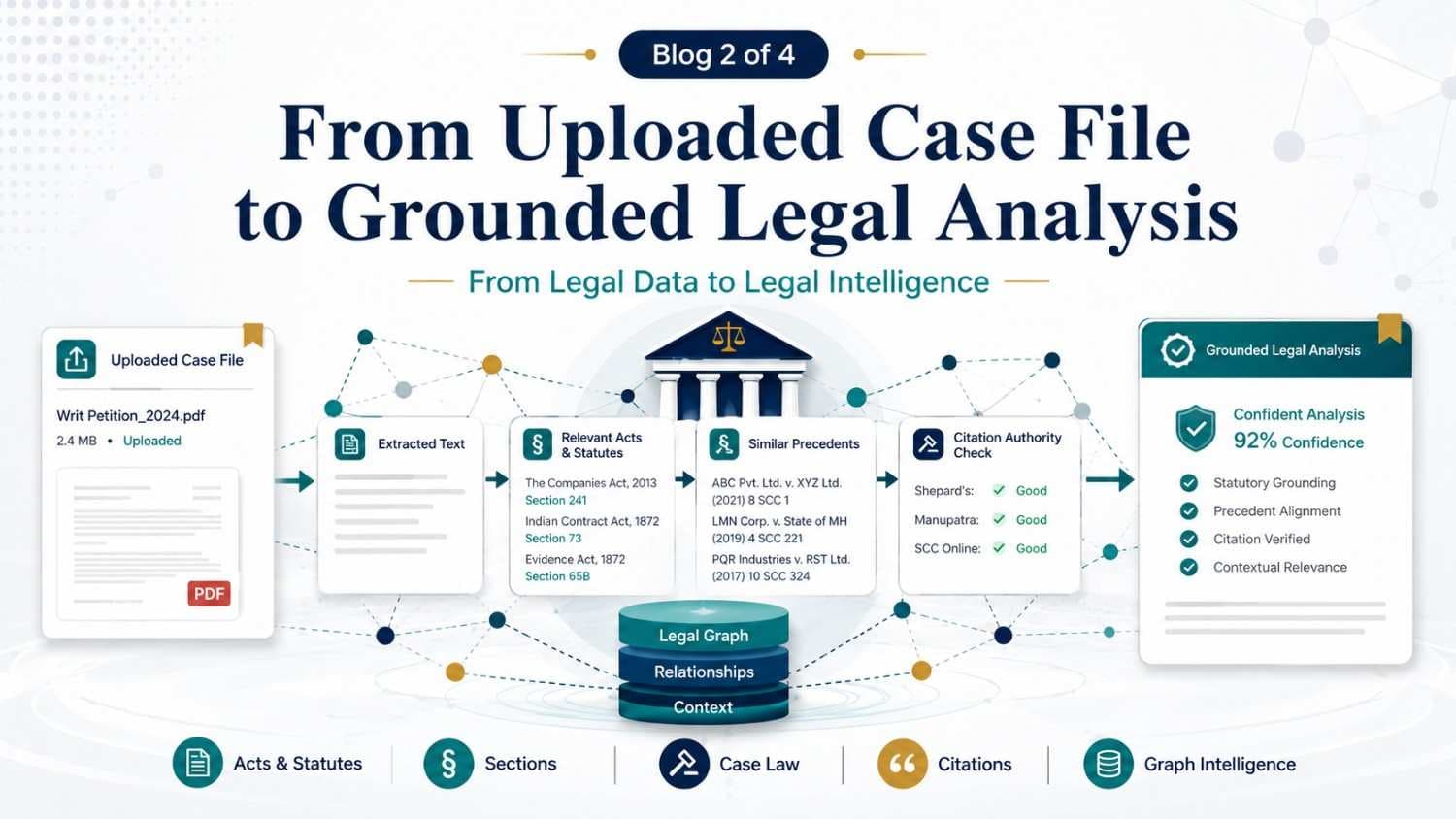
The case predictor is not an abstract concept. A six-stage workflow already exists, connecting uploaded documents, the Bangladesh Legal Acts GraphRAG and a precedent-retrieval system. It uses three GraphRAG tools to ground its analysis in statutory and citation evidence.
The predictor does not run on every conversation
The system uses three safety gates.
First, the prediction feature must be enabled.
Second, the user must provide a valid PDF or DOCX file.
Third, the user’s message must clearly ask the system to predict, analyse or assess the case.
When these conditions are not satisfied, the request continues through the normal legal-assistant workflow.
This keeps case prediction separate from ordinary legal questions and prevents accidental activation.
Stage 1: Turning the document into usable information
The process begins by extracting text from the uploaded case file.
The system evaluates the quality of that extraction as low, medium or high.
This matters because a scanned, damaged or incomplete file should not receive the same level of confidence as a clean digital document.
When extraction fails completely, the analysis is skipped rather than built on unusable text.
That is the first sign of a responsible legal-AI design:
It is allowed to say that the available evidence is insufficient.
Stage 2: Finding relevant Bangladesh Acts
The predictor then searches the Legal Acts GraphRAG for the three most relevant Acts.
It uses legal_act_search to identify possible statutes and legal_act_get_section to retrieve statutory text for enrichment.
This gives the model more than the name of a law. It gives it actual legal content.
Without this step, a language model could produce a fluent analysis while citing a statute that is irrelevant, outdated or entirely invented.
Statutory retrieval creates an evidence boundary around the model’s reasoning.
Stage 3: Searching similar precedents
At the same time, the system searches the past-case corpus using vector similarity.
It retrieves similar judgment excerpts and removes results that fall below the required similarity threshold.
The previous outcome of a case does not necessarily need to live in a separate database column.
Judgment text normally contains operative language such as:
- The appeal is allowed
- The petition is dismissed
- The conviction is upheld
- Bail is granted
- The matter is remanded
- The accused is acquitted
The model can read these passages and identify precedent-derived patterns.
This does not make the system a statistical predictor. It makes it a precedent-informed qualitative analyst.
Stage 4: Measuring citation authority
Not every statute carries the same weight in a legal argument.
The predictor therefore uses legal_act_cited_by to examine how frequently the retrieved Acts are cited within the corpus.
Citation count is mapped to authority levels such as:
- Very high
- High
- Medium
- Low
This is one of the strongest connections between the GraphRAG foundation and the predictor.
The graph is no longer just a map of legal relationships. It becomes an authority signal inside the final analysis.
Stage 5: Creating a structured case assessment
The model receives:
- Extracted case facts
- Relevant statutory material
- Similar precedent excerpts
- Citation-authority information
It then creates a structured assessment covering areas such as:
- Possible outcomes
- Strong grounds
- Weak grounds
- Strategic advice
- Risk factors
- Procedural expectations
- Similar precedents
- Recommended citations
- Sentence considerations in criminal matters
- Missing evidence
The output follows a defined schema rather than an uncontrolled block of text.
The legal disclaimer is also structurally enforced. The response must communicate that the analysis is qualitative, is not legal advice and should not replace consultation with a qualified lawyer.
Stage 6: Confidence is earned, not assumed
The final confidence level depends on the quality of the evidence.
Confidence is reduced when:
- Document extraction is weak
- No similar precedents are found
- Too few precedents are found
- Precedent similarity is low
- No relevant Acts are retrieved
- No citation-authority signal exists
The lowest applicable confidence limit wins.
The system then classifies the result as high, medium or low confidence.
When confidence is too low, it does not display a detailed forecast as though it were reliable. It returns a safer fallback.
This is essential.
A legal-AI product becomes dangerous when polished language hides weak evidence.
Why the system remains qualitative
The predictor is deliberately prevented from claiming:
“You have a 78% probability of winning.”
Such a claim would require a properly labelled dataset containing verdicts, sentencing outcomes, jurisdictions, charges and enough comparable examples to support statistical analysis.
The current system instead provides:
- High likelihood
- Moderate likelihood
- Low likelihood
These are evidence-guided scenarios, not mathematical promises.
That distinction protects the user, the lawyer and the credibility of the product.
What the system is genuinely good at
Even without statistical probability, the predictor can provide meaningful value.
It can help a lawyer or legal team:
- Find statutes connected to a case
- Locate similar judgments
- Identify missing documents or evidence
- Compare strong and weak arguments
- Prepare for procedural questions
- Prioritise next steps
- Open the source judgments for deeper review
- Identify whether recommended authorities are widely cited
This is not an automated judge.
It is an evidence-organising legal assistant.
But the system faces an important challenge.
What happens when the uploaded case file does not mention a statute, section or recognised legal concept?
What happens when the user simply tells a human story?
That is the problem explored in the next article.