
Every time you explain the same business requirement, upload the same document or move an AI response into another tool, work takes longer.
For a small business owner, that friction competes with serving customers. For an HR team, it adds another step between identifying a need and completing a task.
ActionBoard AI’s approach brings together token efficiency, long-term memory and governed execution to reduce that repeated effort. Its promise is practical: help people move from instructions to completed work with less unnecessary processing.
What does token minimization mean?
AI models process information in units called tokens. Instructions, documents, conversation history and generated responses all consume them.
Token minimization means reducing unnecessary information while retaining what the task needs. Removing an irrelevant conversation thread can help. Removing a critical policy or customer requirement can damage the result.
ActionBoard’s proposed approach combines relevant context, focused agent workflows and its long-term memory concept, Voltron Ops. The aim is to carry useful knowledge forward, reducing the need to repeatedly reconstruct the same background.
Imagine a business preparing recurring customer proposals. Its services, approved terms and writing preferences provide reusable context. Each new proposal should focus on the customer’s specific needs rather than require another full explanation of the business.
How much faster could a better workflow be?
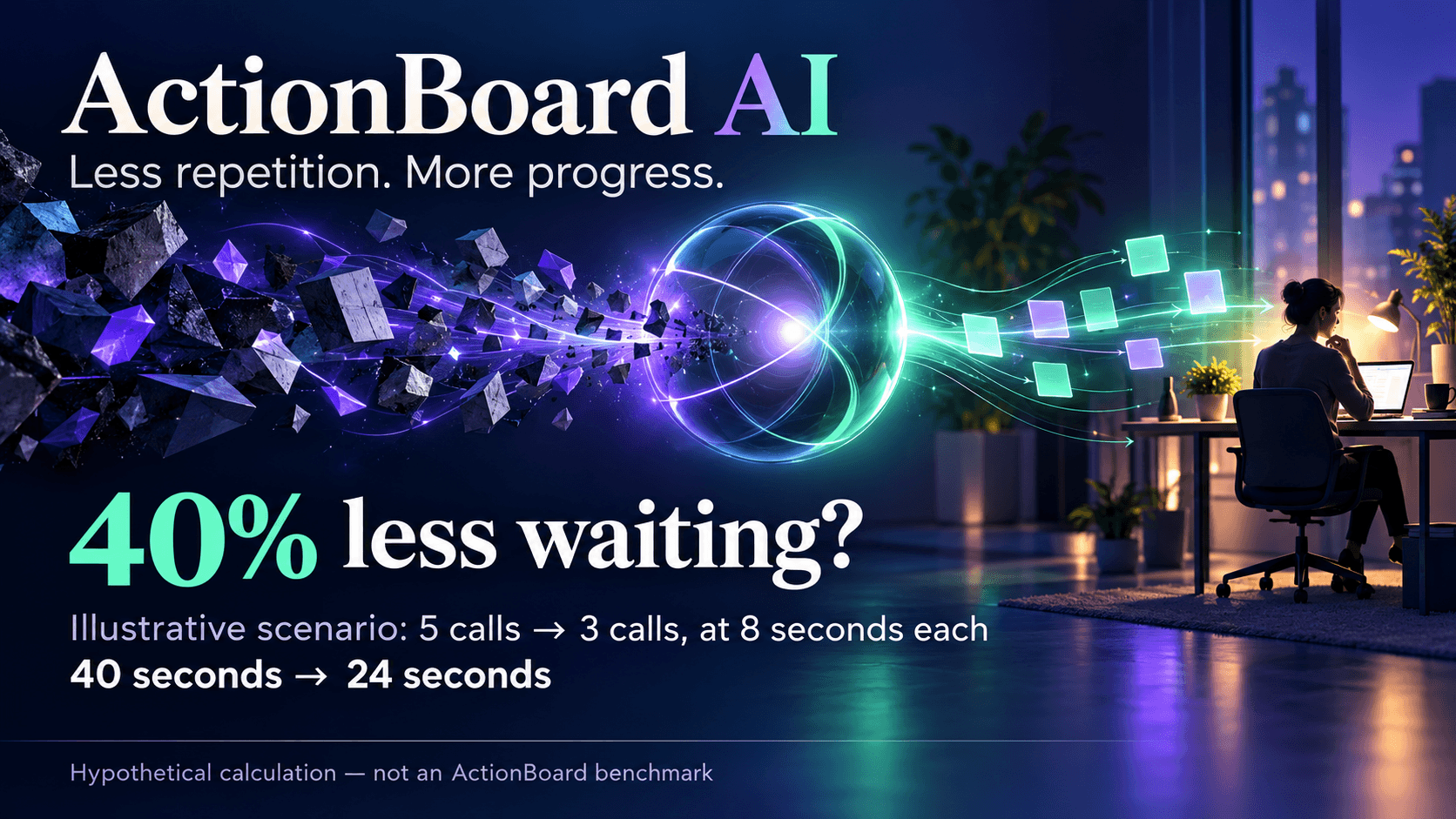
Consider a hypothetical workflow in which several AI requests run one after another. Assume each request takes eight seconds and that two redundant requests can be removed without losing required checks or quality.
| Measure | Original workflow | Streamlined workflow |
|---|---|---|
| Sequential AI requests | 5 | 3 |
| Assumed time per request | 8 seconds | 8 seconds |
| Total AI waiting time | 40 seconds | 24 seconds |
That is 16 seconds saved, or 40% less AI waiting time.
Across 100 identical workflows, the arithmetic becomes 26 minutes and 40 seconds less accumulated waiting.
These figures illustrate a design opportunity. They are not measured ActionBoard results. Actual performance depends on model choice, request complexity, tool response times, required reviews and whether requests can safely be combined.
Fewer tokens do not automatically mean proportionally faster results
A 60% reduction in input tokens does not establish a 60% reduction in completion time.
OpenAI’s latency guidance explains that halving input tokens may improve latency by only around 1–5% in typical cases. Generating shorter outputs and avoiding unnecessary sequential requests can have a larger effect. These are general engineering observations, not ActionBoard performance claims.
For ActionBoard, the opportunity therefore extends beyond shorter prompts: preserve relevant context, avoid redundant processing and organize execution efficiently.
What makes this approach useful?
ActionBoard’s positioning connects three capabilities:
- Memory: Carry relevant knowledge forward across work.
- Execution: Help a task progress through connected steps.
- Governance: Check permissions, involve people where required and record outcomes.
Together, these capabilities aim to reduce the effort between asking for something and getting it done.
A claim that ActionBoard is smarter or faster than a particular competitor would require comparable testing. The meaningful comparison is whether it completes the same task with equal or better quality, less human effort and an appropriate cost.
The human value behind the efficiency
For a woman managing an SME, fewer repeated administrative steps could create more room for customers and planning. For an educator, reusable context could simplify recurring preparation. For HR teams, connected workflows could reduce manual handoffs.
Those are potential benefits that should be demonstrated through real deployments. Useful measures include time saved per completed task, correction rates, processing costs and user satisfaction.
That is where ActionBoard’s ambition becomes meaningful: making everyday work easier to complete, while keeping people involved in decisions that matter.
ActionBoard AI — from prompt to proof, with less repetition along the way.