
Everyone wants to be productive.
You download apps, make to-do lists, organize your notes, maybe even use AI tools to speed things up. For a few days, everything feels under control.
Then reality kicks in.
Tasks pile up. Priorities shift. Deadlines get pushed. And suddenly, you’re back to where you started—overwhelmed, disorganized, and stuck.
The problem isn’t that you don’t have the right tools.
The problem is that you’re still managing everything manually.
The Real Issue: Work Isn’t Connected
Most productivity tools are built around tasks.
You write them down, organize them, maybe assign deadlines—but at the end of the day, they’re still just isolated items on a list.
They don’t:
- understand how tasks connect
- adapt when something changes
- guide execution forward
So when one thing breaks, everything else falls apart.
This is why most systems fail—not because the work is difficult, but because there’s no structure holding it together.
From Task Management to System Thinking
What if instead of managing tasks, you could run a system?
A system where:
- tasks are connected
- priorities are automatically structured
- progress is tracked in real time
- and adjustments happen without constant manual input
This is the shift ActionBoard introduces.
What ActionBoard Actually Does
ActionBoard is not another task manager or AI chatbot.
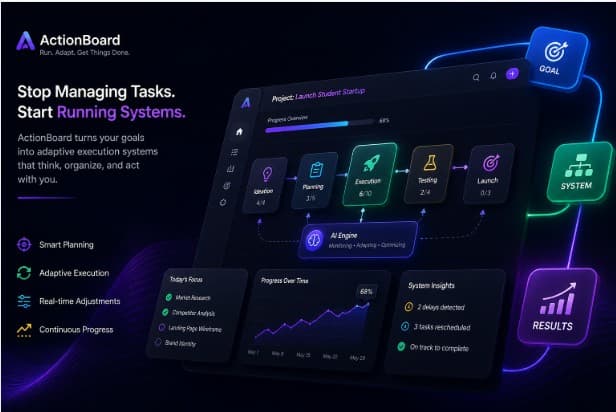
It is designed to turn a simple goal into a structured execution system.
You start with something like:
“Build a portfolio website”
“Launch a small business”
“Complete a university project”
Instead of giving you generic advice, ActionBoard:
- breaks the goal into stages
- creates a structured workflow
- assigns priorities and timelines
- and continuously updates everything as you progress
It doesn’t just help you plan.
It helps you move forward consistently.
How It Works (Without the Complexity)
Behind the scenes, ActionBoard follows a clear flow.
First, it understands your goal—what you want to achieve and how complex it is.
Then, it gathers the necessary context, tools, and information needed to act.
Next, it organizes everything into a structured workflow:
- tasks
- priorities
- dependencies
As you begin working, the system tracks progress. If something is delayed or changes, it adjusts the workflow automatically.
Finally, it supports execution—helping you generate content, structure timelines, and keep everything aligned.
Over time, the system improves based on how you work, becoming faster and more accurate.
Why This Matters for Students and Builders
If you’re a university student, you already know how quickly things can get out of control.
Assignments overlap. Projects get delayed. Motivation drops when structure is lost.
If you’re in tech, it’s the same story:
- ideas are easy
- execution is not
ActionBoard solves this by giving you a system that:
- keeps everything organized
- shows clear next steps
- and adapts when things change
Instead of relying on motivation, you rely on structure.
A Simple Example
Let’s say your goal is:
“Build a portfolio website”
Normally, you would:
- search online for steps
- write scattered notes
- forget important parts
With ActionBoard:
- the process is broken into stages
- tasks are clearly defined
- progress is tracked visually
- timelines adjust as you work
The difference is simple:
You don’t just plan the project.
You complete it.
The Bigger Shift
We’re moving into a world where tools don’t just assist—they operate.
The future of productivity isn’t about:
- doing more
- organizing better
It’s about building systems that:
- understand goals
- structure execution
- and keep things moving forward
ActionBoard represents that shift.
Final Thought
Most people don’t fail because they lack ideas.
They fail because they lack systems that turn those ideas into action.
ActionBoard doesn’t just help you stay organized.
It helps you execute without friction.