
For the last five years, the world has been obsessed with one question:
“What can AI do?”
In 2026, that question is obsolete.
The real question now is far more uncomfortable—and far more powerful:
“What measurable outcome did your AI actually deliver?”
And most organizations don’t have a good answer.
🔥 The Brutal Reality No One Wants to Admit
Behind the glossy demos, keynote presentations, and billion-dollar investments lies a sobering truth:
Over 80% of AI projects fail to deliver meaningful business value.
Not because the technology doesn’t work.
But because organizations misunderstand what success looks like.
AI has been treated like:
- A tool to impress stakeholders
- A symbol of innovation
- A race to adoption
Instead of what it actually is:
A system that must produce measurable, repeatable outcomes.
💡 The Shift That’s Redefining AI
Something fundamental is happening across platforms like LinkedIn, enterprise ecosystems, and research institutions.
The narrative is changing.
From:
- “We implemented AI”
To:
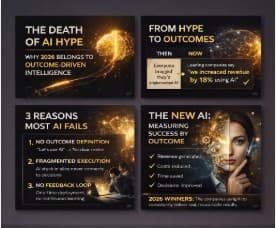
- “We improved revenue by 18% using AI-driven decision loops”
From:
- “We deployed models”
To:
- “We reduced operational inefficiencies by 32%”
This is not a subtle shift.
This is a paradigm collapse of AI vanity metrics.
📉 Why Most AI Still Fails
Let’s break the illusion.
Organizations are failing not because of poor models—but because of poor systems thinking.
1. No Outcome Definition
Most teams start with:
“Let’s use AI here”
Instead of:
“What exact business metric are we optimizing?”
No metric = No direction = No success.
2. Fragmented Execution
AI is deployed in silos:
- Marketing uses one tool
- Operations uses another
- Leadership sees none of it
Result?
Intelligence that never connects to decisions.
3. No Feedback Loop
AI is treated as:
- A one-time deployment
Instead of:
- A continuous learning system
Without feedback, AI becomes static—and static systems fail.
🧠 The Rise of Outcome Intelligence
The companies winning in 2026 are not the ones using the most AI.
They are the ones using AI correctly.
They are building:
Outcome Intelligence Systems
These systems:
- Start with a clear KPI
- Use AI to drive decisions
- Measure results in real time
- Continuously improve through feedback loops
This is not automation.
This is intelligence in motion.
⚙️ From Tools to Systems
Here’s the uncomfortable truth:
Most AI tools are not designed to deliver outcomes.
They generate:
- Content
- Predictions
- Insights
But they stop short of:
- Driving action
- Closing the loop
- Measuring impact
That gap is where most value is lost.
🚀 The Future: Agentic AI That Delivers Results
We are now entering the era of:
Agentic AI systems
Not tools.
Not assistants.
But autonomous systems that think, act, and optimize toward a goal.
Imagine this:
Instead of asking:
“Generate a marketing report”
You deploy an agent that:
- Researches trends
- Identifies opportunities
- Executes campaigns
- Tracks performance
- Optimizes in real time
All tied to one metric:
Business outcome.
📊 The New Definition of AI Success
Let’s make it simple.
AI success in 2026 is not:
❌ Number of models deployed
❌ Number of tools used
❌ Number of experiments run
It is:
✅ Revenue generated
✅ Costs reduced
✅ Time saved
✅ Decisions improved
⚡ Final Thought: The Companies That Will Win
The winners of this decade will not be the most innovative.
They will be the most disciplined.
Disciplined in:
- Defining outcomes
- Building systems
- Measuring impact
- Iterating relentlessly
Because in the end:
AI doesn’t create value. Outcomes do.