
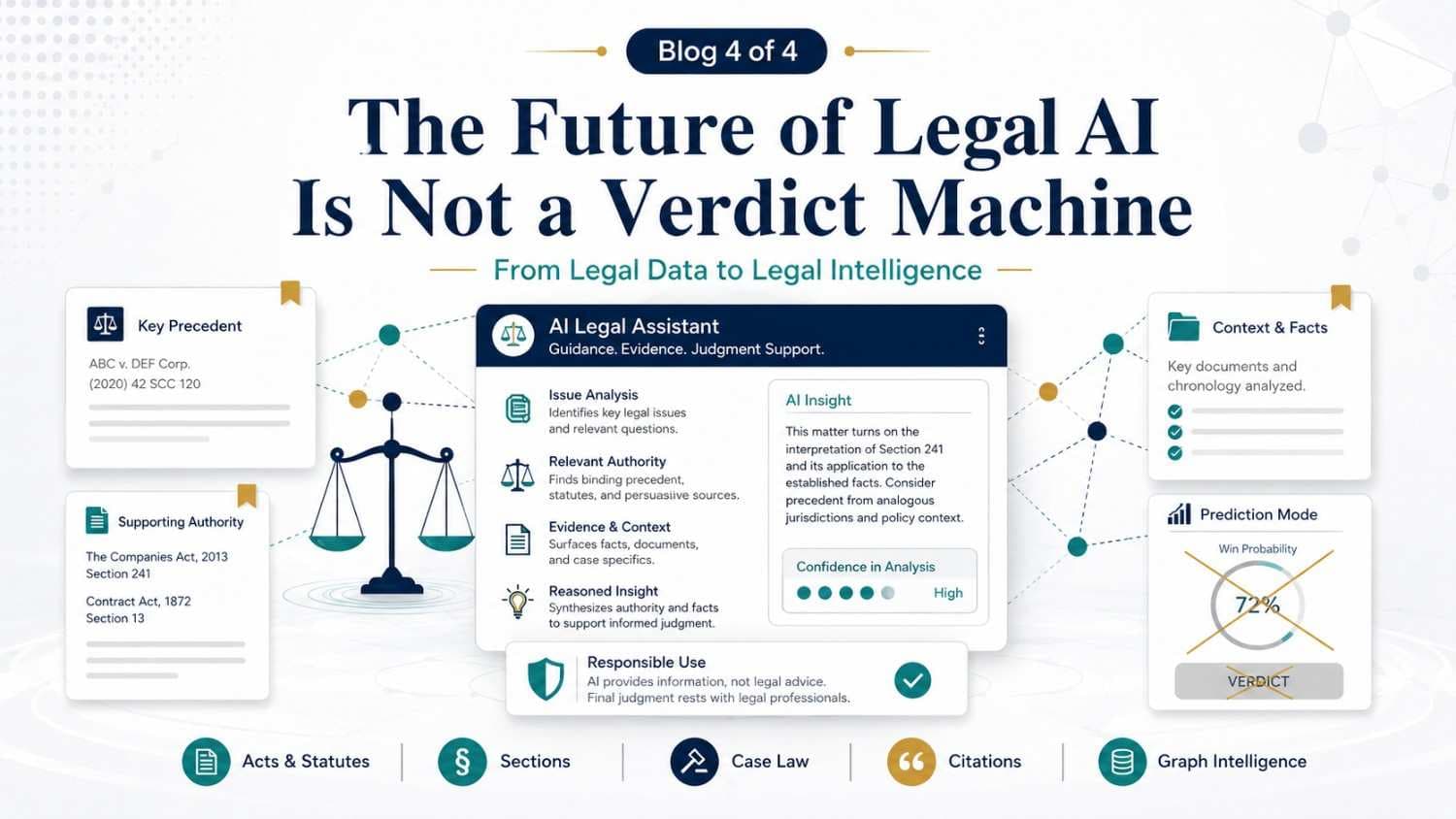
The easiest way to market legal AI is also the most dangerous: “Upload your case and discover whether you will win.”
It sounds powerful.
It is also the wrong promise.
Court outcomes depend on facts, evidence, procedure, advocacy, judicial interpretation and developments that may occur after the analysis is produced.
A responsible legal-AI platform should not pretend to replace that complexity with a percentage.
The more valuable product is not an automated judge.
It is a grounded legal-intelligence system that helps professionals see relevant law, precedent, risk and missing evidence earlier.
What responsible case analysis should provide
A useful legal assistant can answer questions such as:
- Which Bangladesh Acts may be relevant?
- Which sections should a lawyer review?
- What similar judgments exist?
- What happened in those judgments?
- Which grounds appear stronger?
- Which arguments appear vulnerable?
- What evidence is missing?
- Which procedural step may come next?
- Which authorities are heavily cited?
- What should the legal team investigate before filing?
These outputs support professional judgment without claiming to replace it.
That is the correct positioning for the current Legal Orchestrator.
It is a:
Precedent-informed, statute-grounded, qualitative legal analysis assistant.
It is not:
A statistical court-outcome prediction engine.
Guardrails are part of the product, not an afterthought
The current predictor includes several important protections.
Confidence calibration
The system lowers confidence when extraction quality, statutory retrieval, precedent quantity or citation evidence is weak.
Low-confidence fallback
When the evidence falls below the acceptable threshold, the system avoids presenting a complete prediction as though it were dependable.
Qualitative outcomes
It uses high, moderate and low likelihoods instead of unsupported probability claims.
Enforced disclaimer
The output must state that it is qualitative, is not legal advice and should be reviewed with a qualified professional.
Human confirmation during drafting
Before generating formal legal documents, the normal legal workflow confirms the collected case information with the user.
Fabrication restrictions
The system is instructed not to invent court names, case numbers, parties, charges, dates or factual grounds.
These protections may appear less exciting than a win-probability dashboard.
They are also what make a legal-AI product credible.
The technology already exists—but some of it remains underused
The Legal Acts platform currently exposes 11 GraphRAG tools.
Only three are actively used in the predictor:
legal_act_searchlegal_act_get_sectionlegal_act_cited_by
These are the three highest-leverage tools for statutory grounding and citation authority.
However, the remaining tools could support broader legal conversations, including:
- Retrieving complete Acts
- Finding Acts by year or period
- Checking direct citations
- Retrieving bilingual statutory text
- Exploring related concepts
- Exploring amendment chains
- Reading corpus coverage
The problem is not that the tools are unavailable.
The normal legal-agent prompt does not clearly tell the model when to use them. The tools are technically connected, but they are not properly advertised inside the system instructions.
This is a small engineering gap with a large product impact.
A few clear tool-selection rules could unlock much more of the legal graph during conversational legal research.
The synthesizer must also understand legal evidence
Calling the correct tool is only half the work.
The final-answer layer must understand how to present:
- Confidence
- Provenance
- Citations
- Statutory content
- Related Acts
- Recommended next actions
A citation result supported by both DynamoDB and the graph should not be presented in the same way as a weak one-word lexical match.
The interface must preserve the evidence hierarchy created by the underlying system.
In legal AI, presentation is part of accuracy.
Memory is also a legal-safety issue
Long legal conversations frequently unfold over many rounds.
The user may explain:
- The type of case
- The parties
- The court
- The history
- The grounds
- The evidence
- The requested remedy
- Advocate and filing information
The current state system persists this information, but message history is capped.
A long drafting conversation may eventually remove the user’s earliest explanation from the active message window.
That creates a subtle risk: the system may remember the recent form fields but lose the original legal objective or humanitarian context.
Recommended improvements include:
- Increasing the legal-message limit
- Maintaining a structured thread summary
- Preserving structured prediction results for follow-up questions
- Clearing bulky intermediate file data after the final prediction is generated
Memory architecture may sound like a backend issue.
In legal workflows, it directly affects factual consistency.
The roadmap from legal retrieval to legal intelligence
The next generation of the system should focus on four areas.
1. Legal issue extraction
Translate narrative facts into structured legal issues before searching for Acts.
2. Semantic retrieval
Combine keyword search with embeddings so paraphrased legal meaning can be identified.
3. Semantic graph expansion
Populate concepts, doctrines, amendments, authorities and jurisdictions.
4. Better conversational orchestration
Teach the legal agent and synthesizer how to select, interpret and present all available GraphRAG tools.
These improvements do not require abandoning the current architecture.
The two-store foundation—graph for relationships, database for legal content—already provides a reusable base. The same design can eventually support user-uploaded legal knowledge bases, tenant-specific document collections and cross-document citation networks.
What should never change
As the system becomes more capable, it must remain honest about what it cannot know.
It should never promise a guaranteed verdict.
It should never conceal weak evidence behind confident language.
It should never invent legal facts.
It should never prevent the user from reviewing the source law or judgment.
It should never position itself as a replacement for qualified legal counsel.
The future of legal AI will not be won by the system that makes the boldest prediction.
It will be won by the system that helps professionals reach better-supported decisions while making the evidence, limitations and uncertainty visible.
That is the transition from legal search to legal intelligence.
And that is where responsible legal AI begins.