
Role-Specialized Multi-Agent Systems for Enterprise Execution
An ActionBoard.ai White Paper on Agent Specialization, Delegation, Coordination, Shared State, Permission Boundaries, and Verifiable Multi-Agent Execution
Abstract
The rise of large language model agents has created a seemingly intuitive assumption: if one capable AI agent is useful, several cooperating agents should be more capable.
Current research shows that the relationship is considerably more complicated.
Multi-agent systems introduce new failure modes that do not necessarily exist in single-agent architectures. Information can disappear during handoffs. Constraints can weaken as they move between agents. Incorrect assumptions can spread through consensus. Agents may delegate tasks to inappropriate peers, lose track of workflow state, or complete their individual responsibilities while the overall organizational objective remains unfinished.
EntCollabBench, introduced in 2026, evaluates multi-agent systems in enterprise environments with role specialization, permission isolation, cross-departmental workflows and policy approvals. The benchmark finds that current systems still struggle with delegation, context transfer, parameter grounding, workflow closure and decision commitment.
AgentCollabBench identifies another set of weaknesses: instruction decay, false-belief contagion, context leakage and loss of important information across multi-agent trajectories. Its results indicate that collaboration architecture and network topology can materially affect whether constraints survive an execution chain.
MAFBench provides additional evidence that multi-agent architecture itself matters. Under controlled evaluation, different framework-level design decisions produced large differences in latency, planning accuracy and coordination success.
ActionBoard’s Voltron formation represents an architectural response to this problem.
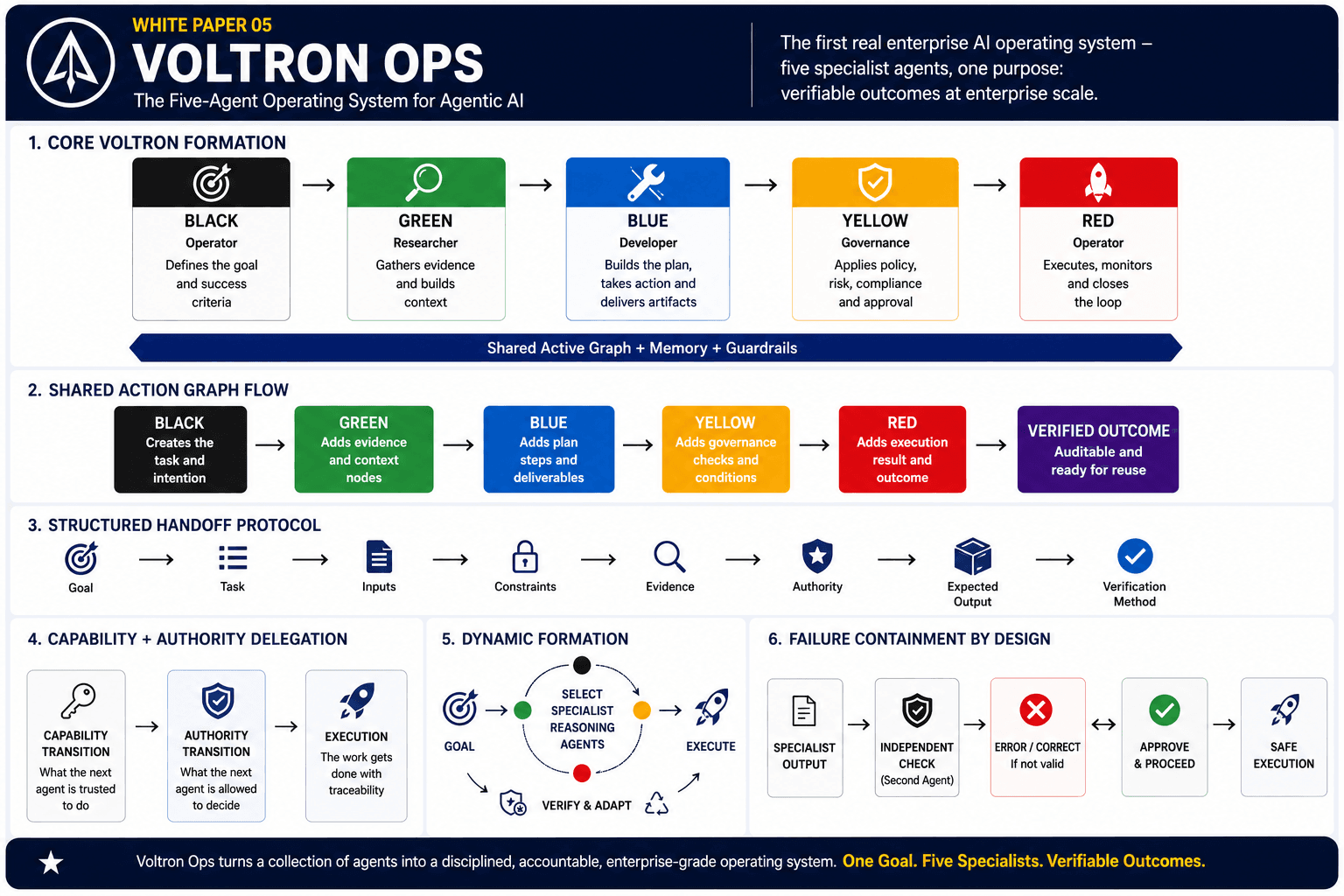
Instead of treating multiple agents as interchangeable copies of one another, Voltron Ops organizes agents according to operational responsibility. In the enterprise formation described by ActionBoard, Black Lion orchestrates, Green Lion handles retrieval, Blue Lion builds, Yellow Lion operates as the security gate, and Red Lion controls deployment or production execution.
The research question behind Voltron Ops is therefore not:
Can five agents outperform one agent?
It is:
Can role specialization, bounded authority, structured handoffs, shared execution state and verification make multi-agent systems more reliable for organizational work?
1. The All-in-One Agent Problem
A general-purpose AI agent is usually expected to perform several fundamentally different types of work.
It may need to:
understand a goal;
plan;
retrieve information;
reason over evidence;
create a work product;
interact with external tools;
evaluate security;
check organizational policy;
request approval;
execute an action;
and verify what happened.
Giving all of these responsibilities to one agent appears convenient.
It also creates concentration of responsibility.
The same reasoning process that proposes an action may be responsible for approving the action, selecting the tool, executing it and then explaining whether it succeeded.
In high-trust enterprise environments, this is an undesirable architecture.
Traditional organizations rarely operate this way.
The employee who prepares a payment is not necessarily the person who approves it.
The developer writing a production change may not have unrestricted authority to release it.
The procurement officer requesting a purchase may not independently approve the purchase.
Role separation exists because specialization and control are both valuable.
Multi-agent AI presents an opportunity to recreate this principle computationally.
2. More Agents Do Not Automatically Produce Better Intelligence
The simplest multi-agent architecture duplicates the same basic model several times and allows those instances to exchange messages.
This can improve some tasks.
But collaboration itself consumes resources and introduces additional failure points.
Silo-Bench identifies what its authors call a communication-reasoning gap: agents may successfully exchange distributed information and still fail to integrate it into a correct shared conclusion. The study further reports that coordination overhead can eliminate some of the theoretical benefits of parallelization as agent count increases.
AgentCollabBench demonstrates that information passing through an agent network can degrade. Constraints that exist at the beginning of a workflow may not reliably survive until the end.
Therefore:
Agent Count ≠ Coordination Quality
The engineering problem is not merely creating multiple intelligent agents.
It is creating a coordination architecture.
3. Specialization Is Only Useful When Roles Mean Something
Consider five agents with different names but identical:
permissions;
tools;
system instructions;
model access;
authority.
This is not meaningful specialization.
It is organizational labeling.
True role specialization requires differences in what agents:
know;
can access;
are responsible for;
are allowed to decide;
are allowed to execute.
EntCollabBench is important because it explicitly models role-specialized agents working within permission-isolated organizational systems rather than giving one agent universal access.
This resembles actual organizations far more closely.
The research implication is:
Role specialization becomes operationally meaningful when roles are linked to capability and authority boundaries.
4. The Voltron Ops Model
For this paper, Voltron Ops refers to ActionBoard’s enterprise formation architecture described in its current feature documentation.
The conceptual formation is:
Black Lion
Orchestration
Responsible for:
goal decomposition;
planning;
execution sequencing;
coordination;
formation management.
Green Lion
Knowledge and Retrieval
Responsible for:
RAG;
Action Graph retrieval;
source acquisition;
context preparation;
evidence discovery.
Blue Lion
Build and Preparation
Responsible for preparing the work required by the goal.
Depending on the workflow, this may include:
analysis;
documents;
structured outputs;
code;
configurations;
workflow components.
Yellow Lion
Security and Governance Gate
Responsible for evaluating:
permissions;
policy;
security;
risk;
compliance conditions.
Red Lion
Controlled Execution
Responsible for consequential deployment or execution once the required authorization conditions have been met.
This creates a separation between:
planning
and
retrieval
and
production
and
governance
and
execution.
That separation is the central architectural idea.
5. The Orchestrator Should Not Become a Dictator
Central orchestration solves some problems.
It can also create others.
If every decision, message and tool invocation must pass through one orchestrator, that component becomes:
a latency bottleneck;
a single point of coordination failure;
an information bottleneck;
a potential security concentration.
Recent multi-agent research therefore explores both centralized and decentralized coordination structures. Research on decentralized multi-agent systems with shared context specifically identifies centralized aggregation as a possible scaling bottleneck under high parallelism.
Voltron Ops should therefore treat Black Lion as the formation coordinator, not necessarily the computational location through which all information must physically travel.
The Action Graph can carry shared execution state.
Specialist agents can contribute state to that graph.
Black Lion can then reason over structured state rather than manually relaying every token between every agent.
6. Shared State Is More Important Than Shared Conversation
Many multi-agent frameworks coordinate through messages.
Agent A tells Agent B something.
Agent B tells Agent C.
Agent C summarizes it for Agent D.
This creates something similar to a game of telephone.
Every handoff creates a possibility that:
a constraint disappears;
a value changes;
context is compressed incorrectly;
provenance is lost.
ActionBoard’s Action Graph offers a different possibility.
Instead of relying exclusively on conversation as shared memory, agents can operate over shared structured execution state. ActionBoard describes its Action Graph as goal-linked and containing sources, actions, decisions, timestamps and compliance information across execution.
A shared state model could therefore allow:
Black Lion
to create a task node.
Green Lion
to attach evidence.
Blue Lion
to attach a deliverable.
Yellow Lion
to attach a governance decision.
Red Lion
to attach the execution result.
The agents do not need to remember everything each other said.
They need to maintain a consistent shared representation of what is true about the execution.
7. The Structured Handoff
A normal agent handoff might say:
“Please finish this task.”
A reliable enterprise handoff should contain substantially more information.
A useful handoff object might contain:
Goal ID
Which organizational objective does this belong to?
Task
What exactly needs to be done?
Inputs
Which information is relevant?
Constraints
What must not be violated?
Evidence
Which sources support the task?
Authority
What is this agent permitted to do?
Expected Output
What constitutes completion?
Verification
How will completion be confirmed?
This gives the receiving agent something closer to a contract than a conversational suggestion.
8. Constraint Survival
One of the most important multi-agent metrics should be:
Constraint Survival Rate
Suppose a workflow begins with ten important requirements.
By the time it reaches the final execution agent, how many remain intact?
Define:
CSR = C_end / C_start
Where:
C_start = valid constraints at formation start;
C_end = constraints correctly preserved at final execution.
AgentCollabBench provides strong motivation for this metric because its instruction-decay tests demonstrate that constraints can disappear as information passes through agent pipelines.
A serious Voltron benchmark should deliberately place important constraints at different locations in the workflow and test whether they survive.
9. Delegation Accuracy
The next question is:
Did the correct specialist receive the task?
A system with specialist agents gains little if orchestration routes work incorrectly.
Define:
Delegation Accuracy
DA = Correct Specialist Assignments / Total Delegations
This should be measured separately for:
explicit delegation;
implicit routing;
exception handling;
cross-domain tasks.
MetaCogAgent provides one recent direction in which agents estimate task-capability alignment and redirect low-confidence work. Its reported evaluation suggests that capability-aware delegation may improve task performance while reducing some unnecessary calls.
The larger idea is valuable for Voltron:
An agent should know not only what it can do, but when another specialist should do it instead.
10. Permission-Aware Delegation
Enterprise delegation is not only about expertise.
It is also about authority.
Suppose Blue Lion prepares a production configuration.
Should Blue Lion deploy it?
Not necessarily.
That task can transfer to Red Lion.
The handoff therefore represents two transitions:
Capability transition
Who is best able to do the work?
Authority transition
Who is permitted to perform the action?
This distinction becomes increasingly important as agents interact with organizational systems.
Research on authorization propagation argues that multi-agent architectures create a separate problem: maintaining authorization boundaries as non-human agents retrieve data and delegate tasks through chains of activity.
Voltron Ops should therefore treat permission information as part of formation state.
11. Formation Topology
Not every problem requires the same collaboration pattern.
Some tasks are linear:
Black → Green → Blue → Yellow → Red
Others may require parallel retrieval:
Green A + Green B + Green C
followed by synthesis.
Others may stop at:
Black → Green → Blue
because no external execution occurs.
Research on enterprise multi-agent strategy suggests that different coordination modes may work better for different classes of problems, and that structured compliance tasks may sometimes favor simpler single-agent strategies rather than unnecessary consensus.
This suggests that Voltron should be a dynamic formation, not a fixed five-agent chain.
The architecture should activate only the roles required by the goal.
12. When One Agent Is Enough
A mature multi-agent system must be willing to use one agent.
If a task is:
low risk;
simple;
fully scoped;
single-domain;
non-consequential,
multi-agent coordination may add unnecessary latency and cost.
The objective is not maximum agent participation.
It is:
Minimum Sufficient Formation
That means:
simple task → one specialist;
complex research → orchestrator + retriever + builder;
consequential execution → full governance path.
This is also where Voltron Ops connects directly to ActionBoard’s token-optimization architecture.
13. Multi-Agent Consensus Is Not Automatically Verification
Several agents agreeing with one another can create confidence.
It does not create truth.
If all agents share:
the same flawed source;
the same false assumption;
the same model weakness,
they may confidently reach the same incorrect conclusion.
AgentCollabBench explicitly investigates false-belief contagion in collaborative agent networks.
Verification should therefore come from stronger mechanisms:
external evidence;
deterministic policy;
tool results;
database state;
tests;
human authorization.
Consensus can be a signal.
It should not be treated as proof.
14. Failure Containment
Role separation also provides an opportunity for failure containment.
If Green Lion retrieves an unreliable source, Yellow Lion may detect policy or evidence problems before execution.
If Blue Lion creates a defective artifact, verification can stop the artifact before Red Lion deploys it.
The formation should therefore be designed so that:
One agent failure ≠ complete workflow failure.
This resembles fault-containment principles in distributed systems.
15. Formation-Level Evaluation
ActionBoard should evaluate Voltron at the formation level, not merely agent level.
A useful benchmark would compare:
Baseline A
Single frontier agent with broad tool access.
Baseline B
Multiple identical general agents.
Baseline C
Role-specialized agents without shared structured state.
Baseline D
Voltron Ops with role boundaries and Action Graph.
Measure:
Goal Completion Rate
Delegation Accuracy
Constraint Survival
Workflow Closure
Permission Violations
Handoff Completeness
Tool Accuracy
Human Interventions
Latency
Token Cost
Verified Outcome Rate
16. Formation Reliability
A useful aggregate metric could be:
FR = G × C × P × V
Where:
G = goal completion rate;
C = constraint survival;
P = permission integrity;
V = verified outcome rate.
The multiplicative structure reflects an important reality:
a workflow that succeeds but violates permission boundaries is not reliable;
a compliant workflow that never completes is not useful;
a completed workflow that cannot be verified remains uncertain.
17. What ActionBoard Must Demonstrate
ActionBoard’s public architecture already provides the conceptual pieces for role-specialized execution and goal-linked traces.
The next research requirement is evidence.
ActionBoard should demonstrate that Voltron Ops produces measurable improvement in:
delegation;
constraint preservation;
authorization;
workflow closure;
failure containment;
cost;
verification.
Until those experiments are published, the strongest scientific description is:
Voltron Ops is an architectural hypothesis informed by emerging evidence that reliable enterprise multi-agent systems require specialization, bounded permissions, structured state and explicit coordination.
Conclusion
The future of multi-agent systems will probably not be defined by how many agents an organization can activate.
It will be defined by how clearly those agents understand:
their responsibility;
their authority;
their inputs;
their dependencies;
their constraints;
their definition of completion.
Recent benchmarks demonstrate that intelligent agents can still be poor collaborators.
The challenge is therefore not simply:
More Intelligence.
It is:
Organized Intelligence.
Voltron Ops proposes a formation in which intelligence is divided by responsibility, coordinated through shared execution state, restricted by role boundaries and evaluated at the level of the complete organizational goal.
The research thesis can therefore be stated simply:
Reliable multi-agent systems should behave less like a room full of chatbots and more like a well-designed operating organization.
Selected References — White Paper 05
- Yu, T., et al. Beyond the All-in-One Agent: Benchmarking Role-Specialized Multi-Agent Collaboration in Enterprise Workflows. EntCollabBench, 2026.
- Mazumder, A., et al. AgentCollabBench: Diagnosing When Good Agents Make Bad Collaborators. 2026.
- Orogat, A., Rostam, A., & Mansour, E. Understanding Multi-Agent LLM Frameworks: A Unified Benchmark and Experimental Analysis. MAFBench, 2026.
- Zhang, Y., et al. Silo-Bench: A Scalable Environment for Evaluating Distributed Coordination in Multi-Agent LLM Systems. 2026.
- Wang, C. & Shu, Y. MetaCogAgent: A Metacognitive Multi-Agent LLM Framework with Self-Aware Task Delegation. 2026.
- ActionBoard.ai. Current enterprise formation, Action Graph and Voltron architecture documentation. Product-specific quantitative claims require independent reproduction.